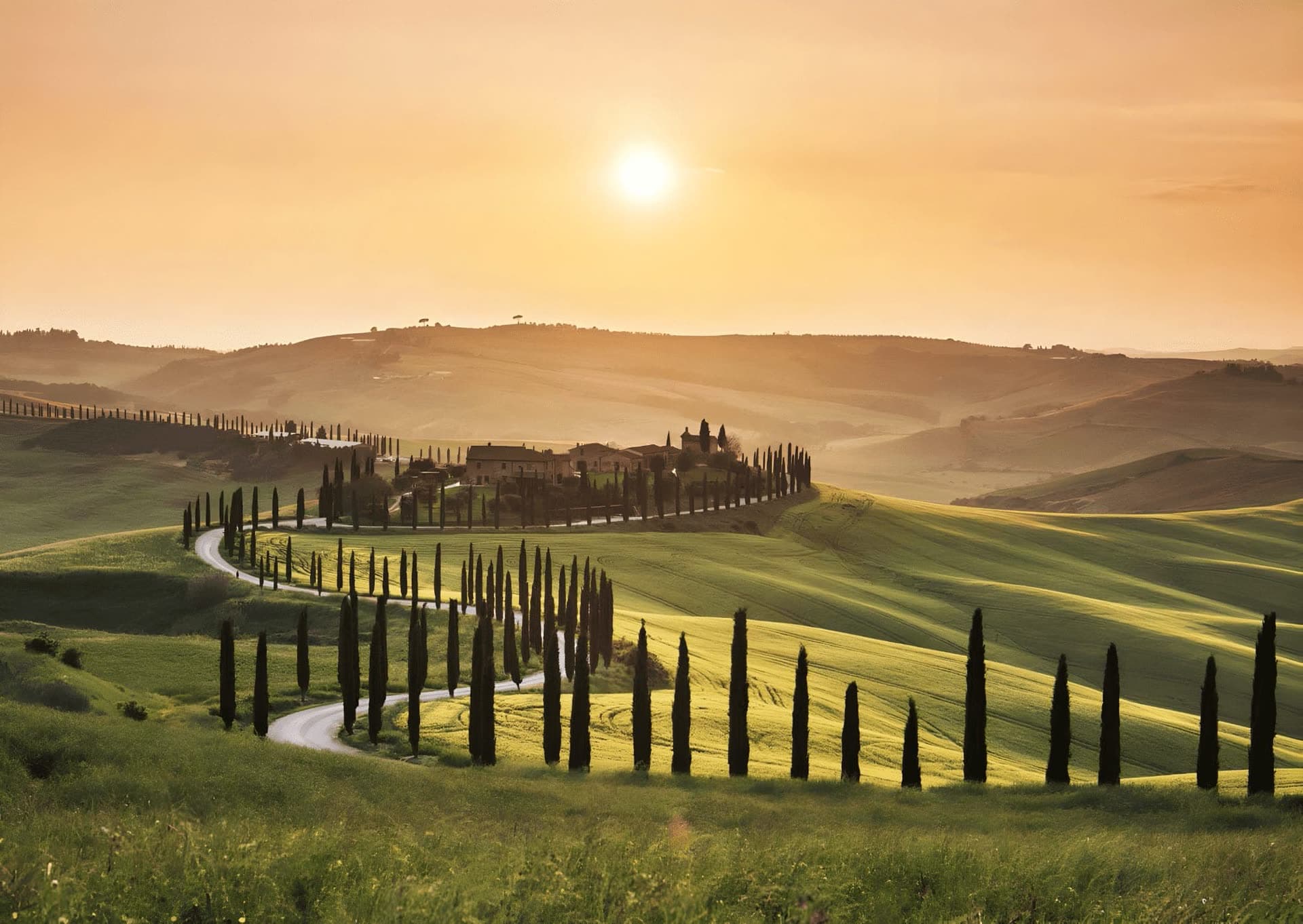
South of Siena the land turns to clay. The Crete Senesi are bare, sculpted hills the colour of raw linen, crossed by strade bianche, the white gravel roads that Tuscany never got around to paving. In 1997 a group of 92 riders in wool jerseys set out from Gaiole in Chianti to save those roads from asphalt, and L'Eroica was born, a vintage ride that grew into a movement. The white roads stopped being a leftover and became a heritage. No other region in cycling is defined by its road surface. This one is.
In 2007 the professionals came. The race now called Strade Bianche starts and finishes in Siena and sends the peloton across the gravel sectors of the Crete, Monte Sante Marie, Colle Pinzuto and Le Tolfe, before the flagstone wall of Via Santa Caterina delivers the survivors into the Piazza del Campo. In under two decades it has become the unofficial sixth monument. Fabian Cancellara won three times and had the hardest sector named after him. Tadej Pogacar has won a record four. The Giro has written its own white-road chapters nearby, Cadel Evans in the 2010 Montalcino mud, a Bernal masterclass on the 2021 gravel stage, and Primoz Roglic announcing himself in the 2016 Chianti time trial.
The riding arranges itself in two acts. Base in Siena or the Chianti hills and the race's gravel is all within a day's loop, ridden between vineyards, battlefield ridges and hilltop towers like San Gimignano's fourteen. Then drift south through the Val d'Orcia, past Montalcino and its Brunello, past Radicofani's lonely tower, to Monte Amiata, the forested volcano whose road to 1,669 metres is southern Tuscany's one true mountain. Ride the white roads in the morning light or just after rain and they glow. That is not a metaphor. They actually do.