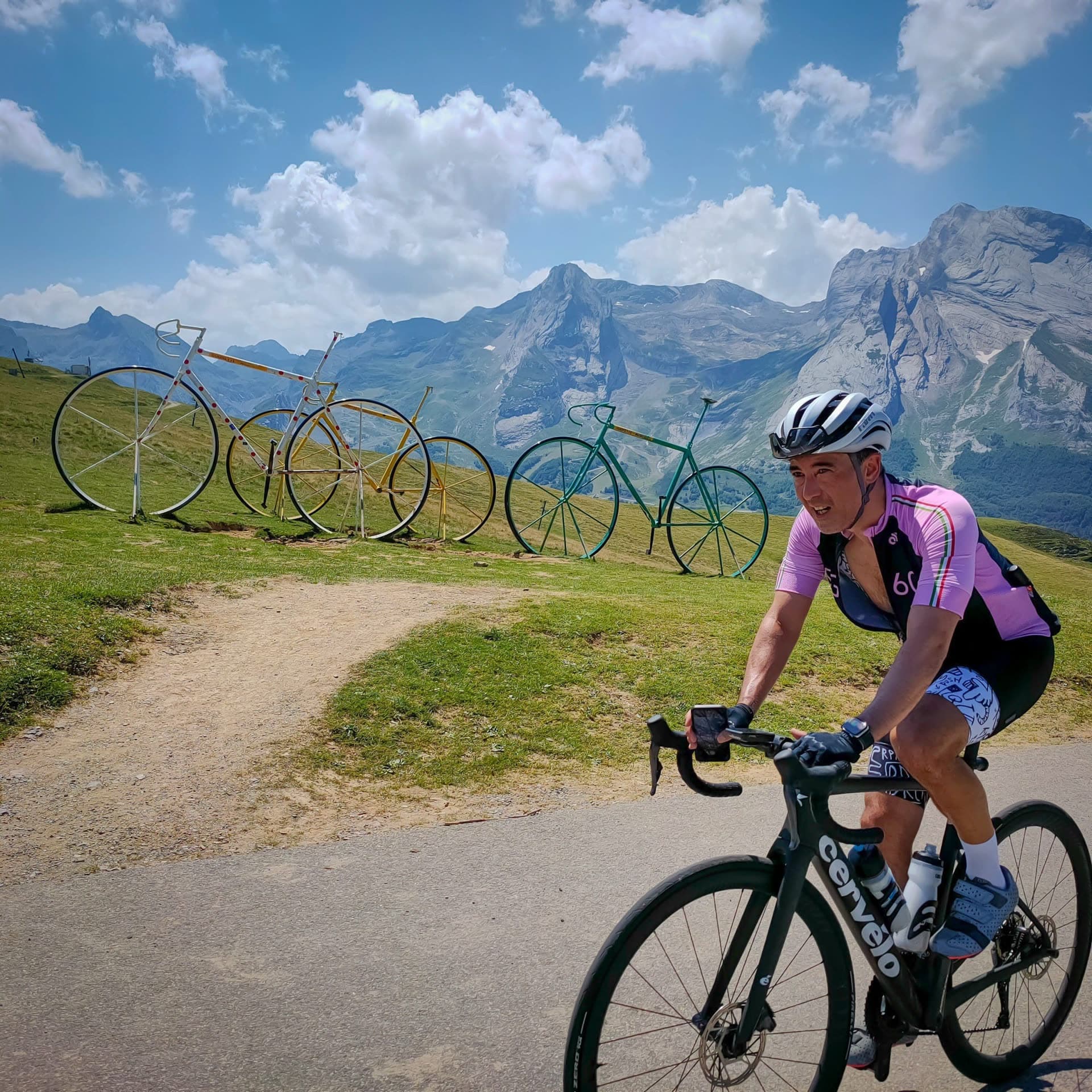
The central Pyrenees are where road racing learned what mountains mean. This is Tourmalet country, the green corridor of the Campan, Aure and Louron valleys running between Bagnères-de-Bigorre and Bagnères-de-Luchon, and it looks nothing like the Alps. The valleys are deep and pastoral, the summits hold sheep rather than glaciers, and the roads are narrow and moody, built for shepherds and spa traffic rather than engineered for armies. Mist rolls up from the Atlantic in the afternoon and the cols disappear and reappear like stage scenery.
The Tour de France came here first, before the Alps, and never really left. In 1910 the race crossed the Peyresourde, the Aspin, the Tourmalet and the Aubisque in one impossible day, and Octave Lapize hissed the word assassins at the organisers as he crested the Tourmalet on foot. Three years later Eugène Christophe carried his broken fork down to the forge at Sainte-Marie-de-Campan and repaired it himself, taking a penalty because a boy worked the bellows. The Tourmalet has now been crossed about ninety times, more than any mountain in Tour history, and the modern race keeps adding floors to the corridor. The Col de Portet opened in 2018 as the highest summit finish in the Pyrenees, Vingegaard broke Pogačar on Hautacam in 2022, and in 2025 the race returned to Superbagnères after 36 years away.
The geography works like a chain. Each valley links to the next over a single col, Campan to Aure over the Aspin or the Hourquette, Aure to Louron over the Azet, Louron to Luchon over the Peyresourde, with the Tourmalet standing at the western gate and Superbagnères closing the east. Base in Saint-Lary-Soulan or Luchon and every climb in this canon is rideable from your door, officials and gems alike, with a coffee stop in a different valley every day.