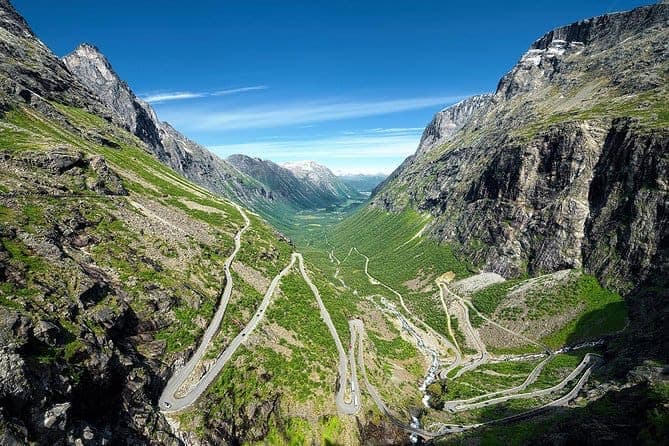
Cycling has two kinds of famous roads. The Alps and the Dolomites earned their names from race history, a century of Tours and Giros deciding themselves on the hairpins. The fjord country earned its fame another way. No professional race has ever climbed Trollstigen or Dalsnibba, and none needs to. These are roads people cross the world to see for their own sake, ladders of stone stitched onto walls that should never have held a road at all, rising out of fjords so beautiful that UNESCO put the Geirangerfjord on the World Heritage list.
The engineering is the legend here. Trollstigen's eleven hairpins were cut by hand between 1928 and 1936, and the road now carries more than a million visitors every open season, which makes it Norway's most visited tourist road. The Eagle Road above Geiranger was blasted out of the fjord wall in 1955 to give the village its only winter lifeline. The old Strynefjell road went up in the 1890s with guard stones instead of guardrails and has been a protected heritage monument since 2009. What race heritage exists is the local hill-climb kind. The Nibberittet sends riders from the Geiranger quay at sea level to the 1,476 metre Dalsnibba skywalk in one savage effort, and the course record stands at 1:07:01. Even Zwift noticed, adding Trollstigen to its Climb Portal so the world could ride a copy.
The riding logic is simple and unlike the Alps. Every big climb starts at or near sea level, so the altitude you gain is the altitude you earn, and a 1,500 metre summit here asks roughly what a 2,700 metre pass asks in Italy. The corridor is compact too. The national tourist route from Geiranger to Trollstigen runs 104 kilometres over two great climbs, and Nordfjord with the Strynefjell sits one fjord south. Base in Åndalsnes for Romsdal or Geiranger for the fjord climbs, ride early before the tour buses wake, and keep a spare day in the plan for weather.